
.png)
Getting a pharmaceutical product into the European market takes serious preparation. You need the right formulation, the right documentation, and a clear understanding of what regulators expect. But there's one factor that shapes the experience from start to finish — the partner you choose to work with.
A strong product can still struggle in Europe if it's backed by the wrong manufacturing or distribution partner. Approvals slow down. Supply gets interrupted. Documentation gaps surface at the worst possible moments. Most companies only fully understand this after they've already felt the consequences of a poor partnership decision.
Fortunately, these problems are largely avoidable. Choosing the right partner isn't complicated, but it does require asking the right questions and knowing what to look for beyond the surface-level pitch. Certifications matter. Track records matter more.
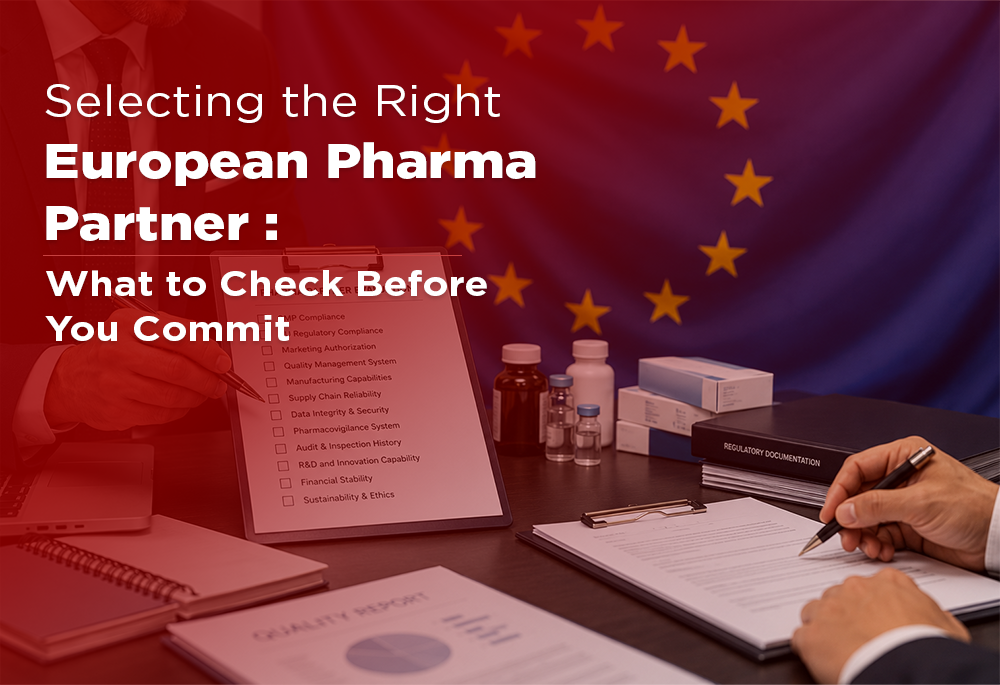
Here's a clear, practical breakdown of what to evaluate before you commit to a European pharma partner — covering compliance, capability, documentation, supply, sustainability, and communication.
Regulatory Compliance Comes First
In the European pharmaceutical market, compliance isn't a box you tick once and move on from. It's the foundation everything else is built on. The European Medicines Agency and national regulatory bodies hold manufacturers to strict, consistent standards — and those standards apply every single day, not just during scheduled inspections.
A valid EU GMP certification tells you a partner has met the regulatory standards. What it doesn't tell you is how they perform between audits. That's the part worth considering. Ask about their most recent inspection outcomes. Find out how quickly they've addressed any observations raised by regulators. A partner who responds to gaps fast and transparently is far more reliable than one with a clean certificate and a reactive approach to compliance.
Pharmacovigilance systems deserve particular attention. In Europe, the requirements around safety reporting and adverse event monitoring are detailed and non-negotiable. A partner without robust, well-maintained systems in this area creates real exposure — both regulatory and reputational.
End-to-end batch traceability is another area to examine closely. From raw material intake through to finished product release, every step needs to be documented clearly and consistently. If a partner can't demonstrate this level of traceability in a straightforward way, that's a meaningful warning sign before you've committed to anything.
Manufacturing Capability — Matching Strengths to Your Needs
No two manufacturers are the same. Each has areas where they're genuinely strong and areas where they're stretched. The goal isn't to find a partner with the most impressive general capability — it's to find one whose specific strengths align closely with what your product actually requires.
Dosage form expertise matters enormously here. A manufacturer with deep experience in oral solids may not be the right fit for a sterile injectable product. Someone who has handled oncology products for years brings a different level of understanding to containment, handling, and quality release than a generalist manufacturer. Be specific about what your product demands and evaluate partners against those exact requirements.
Technology platforms and in-house quality control capabilities also play a bigger role than many companies initially consider. A partner who relies on outsourced testing or uses outdated equipment introduces more variables into the production process. In-house labs with modern equipment and experienced staff give you faster turnaround, cleaner data, and fewer dependencies on third parties.
Scalability is worth planning for early. A partner who can handle your current volumes but has no credible path to scaling production creates a bottleneck the moment your product gains traction. Ask directly about their capacity, their current utilisation rate, and what a scale-up would realistically involve. The answers will tell you a lot about how prepared they are to grow with you.
Documentation and Dossier Support That Holds Up
A well-manufactured product can still face serious delays if the documentation behind it doesn't hold up to scrutiny. In the European regulatory environment, the technical dossier supporting a submission needs to be complete, consistent, and structured in a way that aligns with what different agencies actually expect to see.
This is an area where experience counts. A partner who has been through multiple EU submissions understands the specific language, format, and level of detail that reviewers look for. They know where gaps tend to appear, what questions regulators commonly raise, and how to prepare documentation that minimises back-and-forth during the review process.
Lifecycle management support matters just as much as the initial submission. Products change over time — formulations are adjusted, manufacturing sites shift, specifications evolve. Each of these changes requires a variation submission, and how well your partner handles that documentation directly affects how smoothly those changes go through. A partner who is strong at initial dossier preparation but weak on variations creates friction throughout the product's commercial life.
Consistency across batches and timelines is the other piece. Documentation that looks different from one batch to the next raises questions that regulators don't need to be asking. A partner with clear, standardised documentation processes produces records that are easy to review, easy to audit, and far less likely to trigger delays.
Supply Chain Reliability — Consistency Beyond the Factory Floor
Manufacturing quality means very little if supply isn't consistent. A partner who produces excellent products but struggles to deliver it on time or in sufficient quantity creates its own set of problems — ones that affect market presence, patient access, and your relationships with distributors and healthcare providers.
Start with raw material sourcing. How stable is their supplier base? Do they have approved alternates for critical materials, or does the entire supply chain depend on a single source for key inputs? A partner with diverse, well-qualified raw material suppliers is far better positioned to maintain continuity when disruptions happen — and in today's environment, disruptions happen.
Inventory management and contingency planning are equally telling. Ask what their approach is when demand spikes unexpectedly or when a manufacturing issue requires a batch to be held. A partner who has thought carefully about these scenarios and can walk you through their response process is a better option.
On-time delivery track record is one of the most straightforward things to evaluate — and one of the most revealing. Request data. A partner who is genuinely confident in their supply performance will share this information readily.
Sustainability and Ethical Practices in the European Market
Sustainability has moved well beyond being a nice-to-have in the European pharmaceutical space. Regulators, healthcare systems, and institutional buyers across Europe increasingly expect companies to demonstrate responsible practices — not just in their own operations, but throughout their supply chain.
Are the suppliers in that chain operating to standards that hold up under scrutiny? These questions matter both from a compliance standpoint and a reputational one. A partner who can answer them clearly and confidently has genuinely thought through their supply chain rather than just the manufacturing end of it.
Beyond the regulatory angle, sustainability credentials increasingly influence procurement decisions by hospital networks and national health systems across Europe. A pharma partner with strong sustainability practices isn't just easier to work with from a compliance perspective — they actively support your positioning in a market that rewards this kind of accountability.
Communication — The Underrated Factor in Long-Term Partnerships
While all the factors are important, but poor communication can undermine even the most technically capable partner. In each of these situations, a partner who communicates clearly and quickly makes a tangible difference to the outcome.
Proactive communication highlights a reliable partner. A partner who flags potential issues before they become problems, shares relevant information without being asked, and keeps you informed during critical phases is one who understands that the relationship extends well beyond the manufacturing floor.
Pay attention to how a potential partner communicates during the evaluation process itself. Are they responsive? Do they answer questions directly or deflect with generalities? Is there a clear point of contact who understands your account, or do you get bounced between different people each time? The way a partner behaves before you've signed anything is usually a reliable indicator of how they'll behave once you have.
Cross-team alignment is worth checking, too. In complex partnerships, different teams — regulatory, quality, logistics, commercial — need to be working from the same understanding of your requirements. A partner with strong internal coordination produces far fewer of the miscommunications and dropped handoffs that cause delays in practice.
Conclusion
Choosing a European pharma partner is one of the more consequential decisions you'll make when entering or expanding in this market.
The six areas covered here — regulatory compliance, manufacturing capability, documentation support, supply chain reliability, sustainability, and communication — give you a structured way to evaluate any partner against criteria that actually matter. Not just what they claim on a website or in a sales meeting, but what they can demonstrate through track records, data, and the way they engage with your questions.
The best pharma partnerships in Europe aren't transactional. Take the time to ask the hard questions early. The answers will tell you everything you need to know.
Latest Insights and Updates
Explore our latest articles on pharmaceuticals and healthcare.


VPG Blog
What Makes an Injectable Product Export Ready for Europe
Europe has one of the strictest pharmaceutical regulatory systems in the world. For injectable medicines, the expectations are even higher. These products bypass the body’s natural defense barriers. Because they are administered directly into the bloodstream, muscle, or tissue, there is very little tolerance for error.